

Through the Buyer's Lens: How Buyer's Actually Value a Business
You don’t get to skip the seasons in life. Kids grow up. Roles change. And eventually, every business owner reaches the point where the business moves on without them.
Most owners know that. They just don’t spend much time thinking about it until they have to.
Because it’s uncomfortable. Because it’s complex. Because it feels like something for “later.”
Until it’s not.
Financial Literacy Month usually talks about saving and spending.
Let’s talk about something more relevant.
At some point, your business is going to be sold, transferred, or shut down.
The problem is, most owners don’t really understand how that process works until they’re already in the middle of it.
So let’s remove some of the mystery and start using this as a lens for how you run your business today.
Because buyers aren’t just looking at what your business looks like today. They’re looking at how it’s been built over time.
That’s where I wanted to start this series.
So I asked M&A advisor and CEO of Evolution Advisors, Randy Hendershot, to help us look at a business through the buyer’s lens — because ultimately, the buyer is the one writing the check.
Randy spends his time working with owners who are actively going through the process of selling their businesses. He sees what buyers look for, where deals fall apart, and what separates businesses that sell from those that don’t.
Randy sees what happens during the deal. From my seat, I help owners prepare for what happens before and after it.
Here are a few things Randy told me every owner should understand.
Through the Buyer’s Lens, Value Starts With a Valuation
One of the first things Randy recommends is to get a valuation done now, whether you plan to sell or not, and then revisit it 3–5 years before a sale so you understand the real drivers behind your business value.
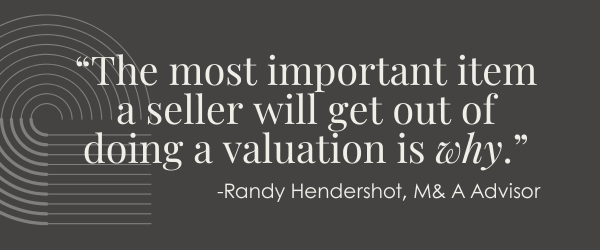
Not because they’re selling now, but because they need to understand what drives the value of the business. The most important thing a valuation tells an owner isn’t just the number. It’s why the business is worth that number.
Once you understand that, you can start working on the things that increase value and reduce risk over time instead of just hoping it’s there when you’re ready to sell. A valuation done early becomes a roadmap for preparing a business for sale.
There’s another reason this matters.
For many owners, their business represents the majority of their net worth. If you don’t know what your business is actually worth, it’s very difficult to do real personal financial planning. Retirement decisions, lifestyle decisions, when you can step back, how much risk you can take — all of those decisions are tied to the value of the business.
What that means for an owner: A valuation isn’t just a number for a future buyer. It’s a number that helps you make better decisions about your life and your business today.
Through the Buyer’s Lens, Value Is About Risk
When I asked Randy what buyers really look at, he said most owners think value is about profit — and he’s right, profit is a major value driver. But buyers are also asking a different question:
How risky is this business after the owner leaves?
From a buyer’s perspective, risk shows up in a few key areas:
- Is the owner the business?
- Is there customer concentration?
- Is there recurring revenue?
- Are there systems and management in place?
The less risk a buyer sees, the more the business is worth. Not because the numbers changed, but because the risk changed.
What that means for an owner: You’re not just building a profitable business. You’re building a transferable business that someone else would actually buy.
Through the Buyer’s Lens, The Owner Can Be the Risk
Randy said one of the biggest value drivers is how dependent the business is on the owner.
If the owner manages key relationships, employees, and day-to-day operations, a buyer sees risk — because a lot of the value walks out the door when the owner does.
If there’s a management team, documented systems, and the business can run without the owner, the value goes up because the risk goes down.
What that means for an owner: The more the business depends on you, the less valuable it may be to a buyer.
Through the Buyer’s Lens, Surprises Are Expensive
Randy told me deals usually don’t fall apart because the business is bad. They fall apart because something shows up late that should have been addressed or disclosed early.
As an intermediary, his team works with sellers to surface these issues before going to market. Some things can be fixed, like getting financials cleaned up. Other things, like customer concentration, may take years to improve or may not change at all — but buyers need to know about it upfront.
Where deals really get into trouble is when something shows up during due diligence that the buyer didn’t expect, especially if it was something the seller knew and didn’t disclose early.
What that means for an owner: You don’t need a perfect business to sell. But you do need to know your business, fix what you can, and be upfront about what you can’t. Most problems don’t kill deals. Surprises do.
Through the Buyer’s Lens, Selling Takes Time
Another thing Randy sees all the time is owners underestimating how long the process of selling a business takes.
Every deal is different, but as a general guideline, most transactions take roughly:
- 6-12 months to sell
- 6-12 months of the transition after the sale
It could be shorter. It could be longer. But it’s rarely quick and clean like people imagine.
Owners think in terms of when they want to be done. Buyers think in terms of how long they need the owner to stay.
Most owners plan the day they sell. Very few plan the years leading up to it.
What that means for an owner: Selling a business is not an event. It’s a process, and most of that process starts years before the deal ever happens.
Through the Buyer’s Lens, You Need a Chapter Three
This might have been the most interesting part of my conversation with Randy.
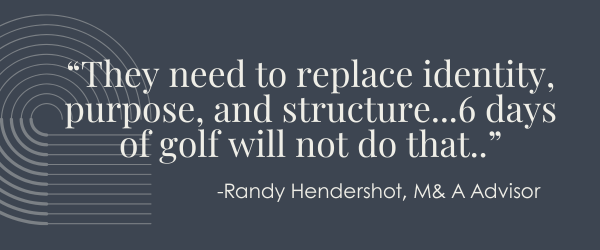
He said when owners sell, they don’t just leave a business. They leave identity, purpose, and structure. And those have to be replaced with something.
He told me he often asks owners what they’re going to do after the six-month RV trip or the travel and golf. A lot of them don’t have a clear answer. And sometimes that’s the real reason they don’t sell.
What that means for an owner: A successful sale solves a financial transaction. It doesn’t automatically solve what comes next in life.
If You Plan to Sell Your Business Someday, Start Here
From Randy’s perspective, owners who have the best outcomes usually do these things early:
- Get a business valuation today, and at a minimum 3-5 years before they plan to sell, then revisit it regularly
- Reduce owner dependence, ideally by building a management team
- Diversify customers where possible
- Build recurring revenue
- Clean up financials and reporting
- Understand that selling takes time, including the transition
- Document systems and processes
- Start thinking today about what life looks like after the business
From My Seat
Randy sees what happens during the deal. From my seat, I help owners prepare for what happens before and after it.
Over the years, I’ve found that most big decisions for business owners don’t live in one place. They sit at the intersection of the business, the financial plan, taxes, lending, and life outside the business.
Each advisor sees part of the picture. My role is to help owners see how all the parts fit together, so the decisions they’re making in their business actually line up with their financial life and what they want life to look like.
The owners who have the best outcomes usually aren’t the ones who got lucky with timing. They’re the ones who planned earlier, coordinated the right people, and made decisions on purpose instead of by accident.
One Question to Sit With
If you were the buyer…
Would you buy your business today?
Most owners only sell a business once. You want someone on your side who has seen it many times.
Randy is someone we trust and someone we bring into conversations when clients start thinking about a transition. If selling your business is something you may consider, even if it’s years away, getting his perspective early can make a meaningful difference.
That’s where we tend to spend time with owners—helping them think through value, risk, and what life looks like on the other side of the business.
If you’re curious about Randy and the work his team does with business owners, you can learn more about Evolution Advisors HERE
Van Hulzen Financial Advisors is an investment advisory firm registered with the Securities and Exchange Commission (“SEC”). SEC registration does not imply a certain level of skill and or expertise. The material presented is for informational and educational purposes only. It is not meant to be considered investment advice or a solicitation to purchase or sell any securities. Van Hulzen is not a tax advisor. Any professionals highlighted in the material presented are not affiliates of Van Hulzen. The opinions, thoughts, views, or commentary expressed do not represent the official views of Van Hulzen or its employees. The information provided by any of the outside professionals highlighted has not been verified for accuracy.